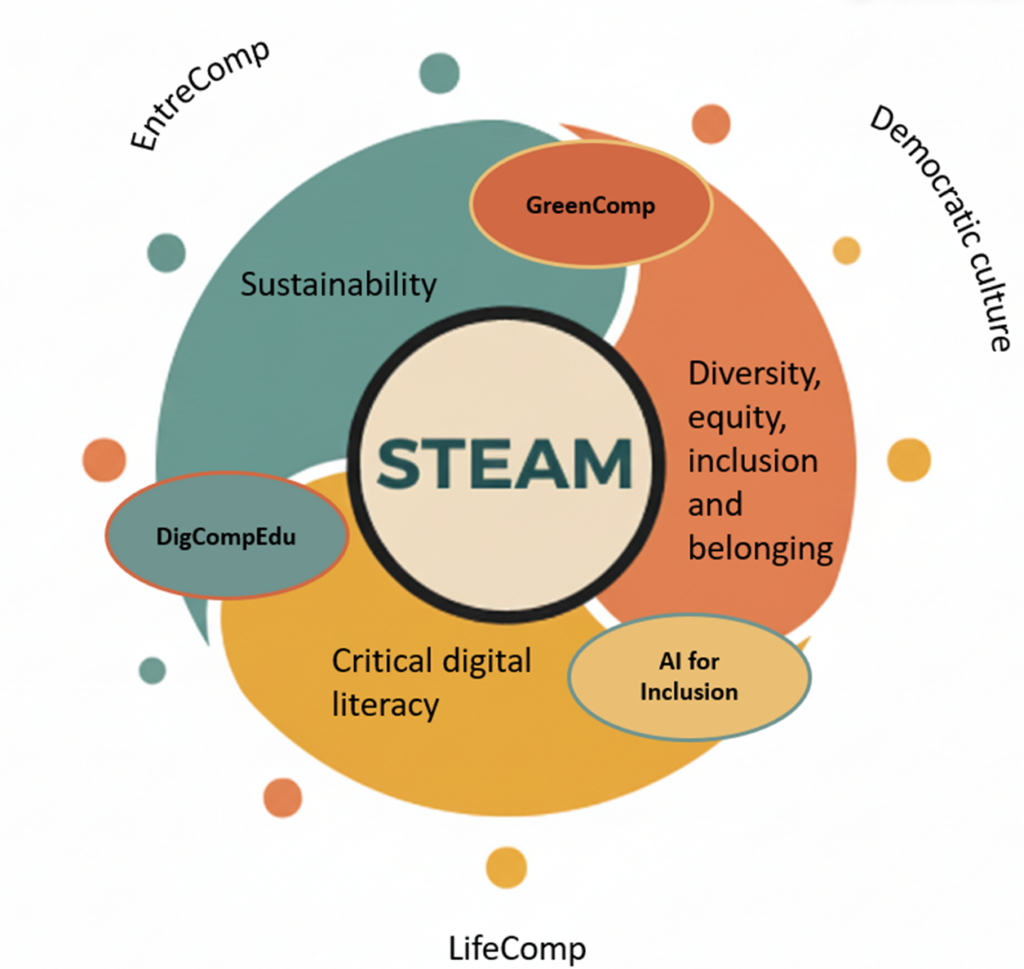
The SMARTIVERSE Framework proposes to integrate STEM education with critical futures-oriented perspectives: Sustainability, Critical Digital Media Literacy and Diversity, Equity, Inclusion and Belonging (DEIB) perspectives. and Democratic Cultures perspectives.
Environmental sustainability education aims to develop skills that enable people to understand and act on environmental challenges. Its core elements include systems thinking, scientific literacy, ethical reasoning, and personal and civic action (GreenComp, EntreComp).
Critical Digital Media Literacy encourages to use digital tools responsibly and to think critically about how digital technologies shape and affect the future (DigComp3, CML Framework, AILit).
Diversity, Equity, Inclusion and Belonging principles means that participation of everyone can be improve, thus also improving engagement for everyone. This supports a democratic culture and foster the goals of LifeComp (RFCDC, LifeComp).
Watch the video introducing the SMARTIVERSE FRAMEWORK
METHODOLOGY
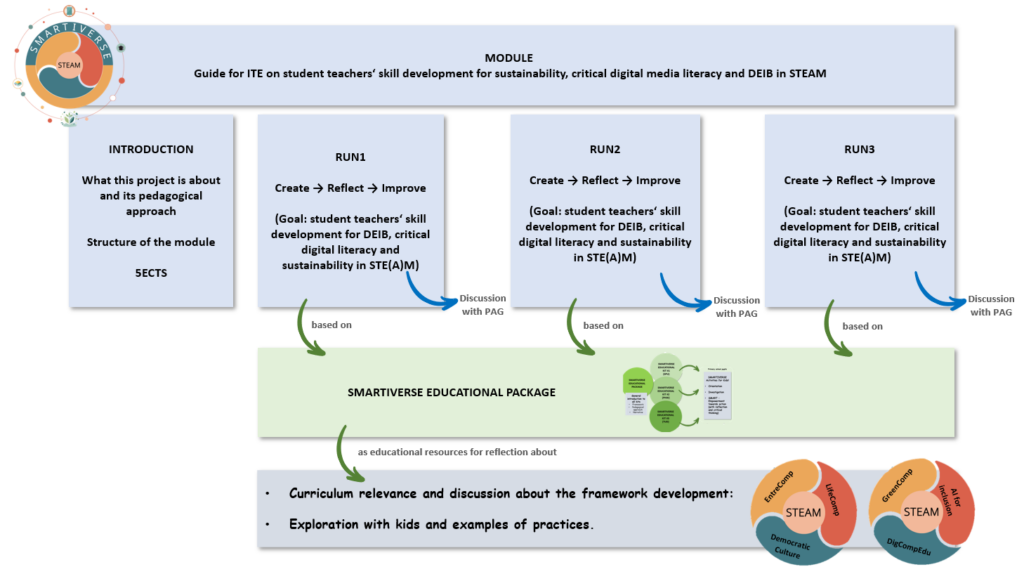
Design-Based Research (DBR) and Action Research: Smartiverse applies Design-Based Research (DBR) as the main design methodology. DBR is an iterative methodology that involves the continuous design, implementation, and evaluation of educational interventions in real-world settings. By pairing DBR with action research, the SMARTIVERSE project ensures that teacher education modules and OER are refined through multiple cycles of classroom implementation and analysis across different European contexts. A Pedagogical Advisory Group (PAG) contributes for critical reflection about the results of each run and gives feedback for improvement.
SMARTIVERSE Module for Initial Teacher Education